
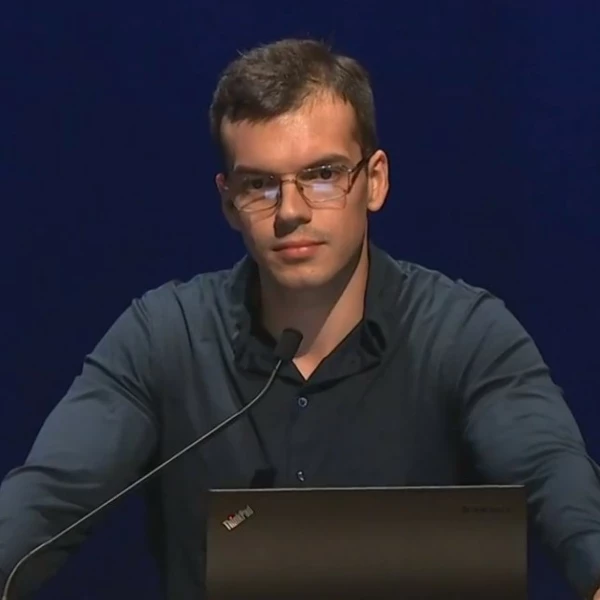
Randall Balestriero
Brown University
Counterfactual JEPAs for World Models in the Real World
Read abstract and bio →October 1, 2026 | 13:30 - 18:00 | Strasbourg, France
Brown University
Counterfactual JEPAs for World Models in the Real World
Read abstract and bio →
Raidium
Foundation models in radiology: One model for all tasks?
Read abstract and bio →Randall Balestriero (Brown University)
Counterfactual JEPAs for World Models in the Real World
Corentin Dancette (Raidium)
Foundation models in radiology: One model for all tasks?
This talk presents a sequence of recent results on Joint-Embedding Predictive Architectures (JEPAs), spanning self-supervised representation learning, action-conditioned world models, and counterfactual reasoning. We begin with LeJEPA, which addresses representation collapse through a distributional principle: embeddings are regularized toward an isotropic Gaussian using Sketched Isotropic Gaussian Regularization, producing a simple predictive objective with theoretical guarantees and without teacher–student networks or stop-gradient heuristics. We then introduce LeWorldModel, which extends this construction to sequential data by learning an encoder and action-conditioned latent transition model, end-to-end from raw observations. By combining next-embedding prediction with Gaussian latent regularization, the model supports planning and control directly in representation space, without reconstructing future pixels. Finally, we discuss new directions in counterfactual JEPAs, where object-level masking and latent interventions create structured partial-observability problems that force the predictor to model interaction-dependent dynamics rather than exploit local correlations. Throughout, we emphasize the geometric and statistical principles connecting these methods, and ask when latent prediction is sufficient for learning causal, controllable abstractions of a dynamical world.
Randall is an Assistant Professor of Computer Science at Brown University, and a leading expert on self-supervised learning, JEPAs, and World Models.
In this talk, he will review recent work on foundation models for radiology and present Raidium's current research, looking at how well existing models can support different tasks such as abnormality classification, fine-grained segmentation and report generation.
Corentin Dancette is Chief Research Officer at Raidium, where he leads research on foundation models for radiology. His work spans image-text alignment, radiology report generation, self-supervised learning, image segmentation, and object detection, and their team open-sourced foundation models such as Curia, Jolia, and RadSAM. Before joining Raidium, he completed his PhD at Sorbonne Université, where he worked on deep learning at the intersection of computer vision and language.